KaplanPrints
KaplanPrints
  • Home
  • Explore the Archive
  • Gallery
  • The Story
  • About
  • More
    • Home
    • Explore the Archive
    • Gallery
    • The Story
    • About
  • Home
  • Explore the Archive
  • Gallery
  • The Story
  • About

Witness to History

From World War II to social protest to 9/11 — bearing witness.

Learn More About Stan

Titles & Info

Thomas Jefferson

Woodcut, 1951 · Poster Size (TBD)

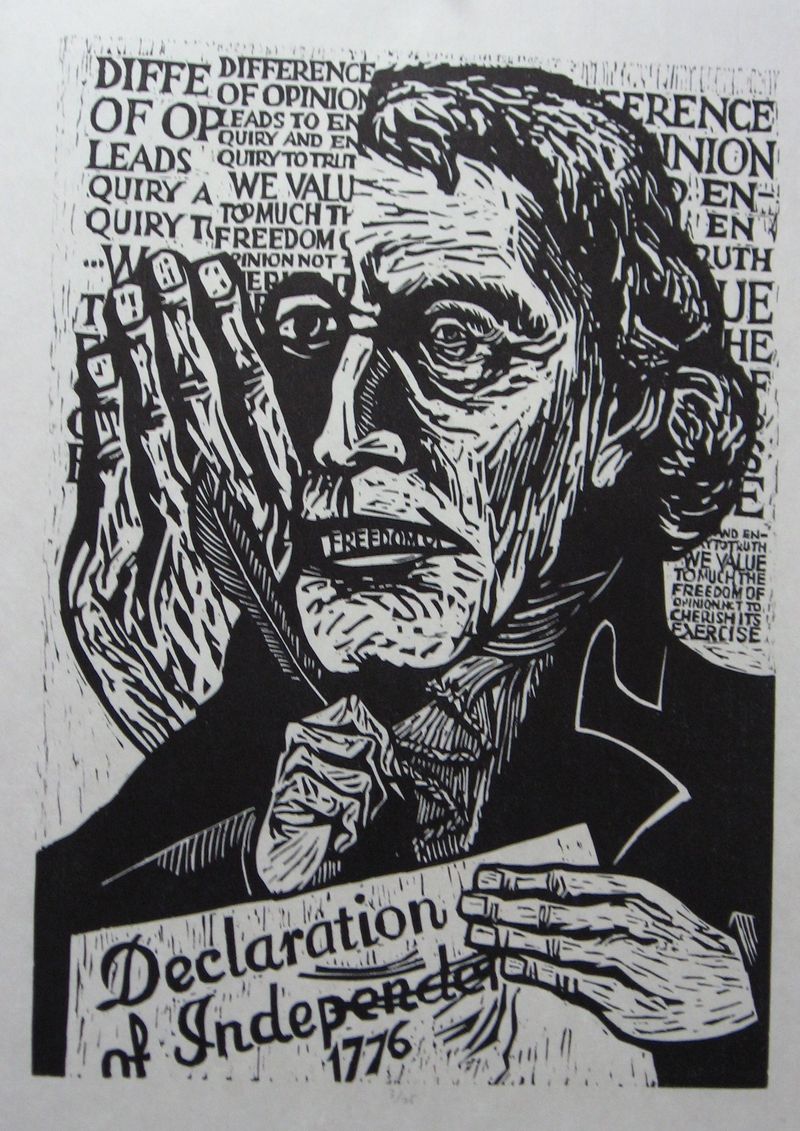
A bold poster print built almost entirely in black and warm ochre, Jefferson's face rendered in dense, textured line as he sits mid-thought, quill in hand, the Declaration of Independence taking shape beneath his fingers. A passage on the freedom of opinion runs down the left margin in blocky, hand-carved type, giving the print the weight and urgency of a protest poster. Made as part of the American Graphic Workshop, a New York artists' collective active in the postwar years, though few records of the group survive today.

Thomas Jefferson

Woodcut, 1970 · Size TBD

A later return to the same subject, nearly two decades on — Jefferson's portrait now stands alone, freed from the poster's declaration text, with only the same quotation on freedom of opinion carved beside him and his signature below. The face is rendered with even more weathered detail than the 1951 print, the line work slower and more deliberate, a quieter reckoning with the same figure and the same words.

Thomas Jefferson

Linoleum Cut, 1990 · Size TBD

A final, more turbulent approach to the same subject, decades after the first. The declaration text no longer sits quietly beside the portrait — it crowds and fractures across his face, repeating, overlapping, breaking apart into illegible fragments. The word "FREEDOM" cuts directly across his mouth. Where the earlier two prints held Jefferson's words at a respectful distance, this version presses them into the man himself, unresolved.

Demonstration

Color Linoleum Cut, 1980 · Size TBD

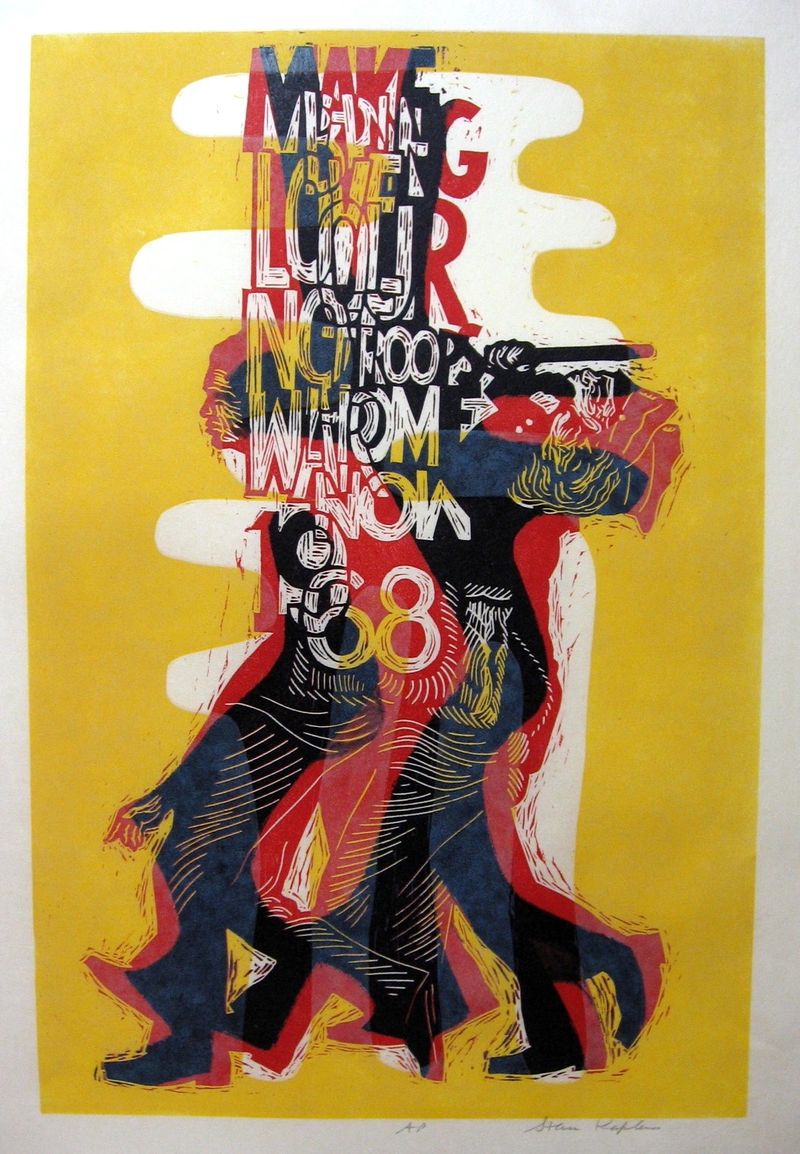
Layers of fractured, overlapping text — fragments of protest language and the year 1968 — stack and collide over marching figures rendered in bold red, black, and blue against a hot yellow ground. The words compete for space the way voices do in a crowd, urgent and hard to fully read, while the figures below move forward together, caught mid-stride.

Severed (from Images: Between the Lines)

Linoleum Cut, 1997 · 24 x 17"

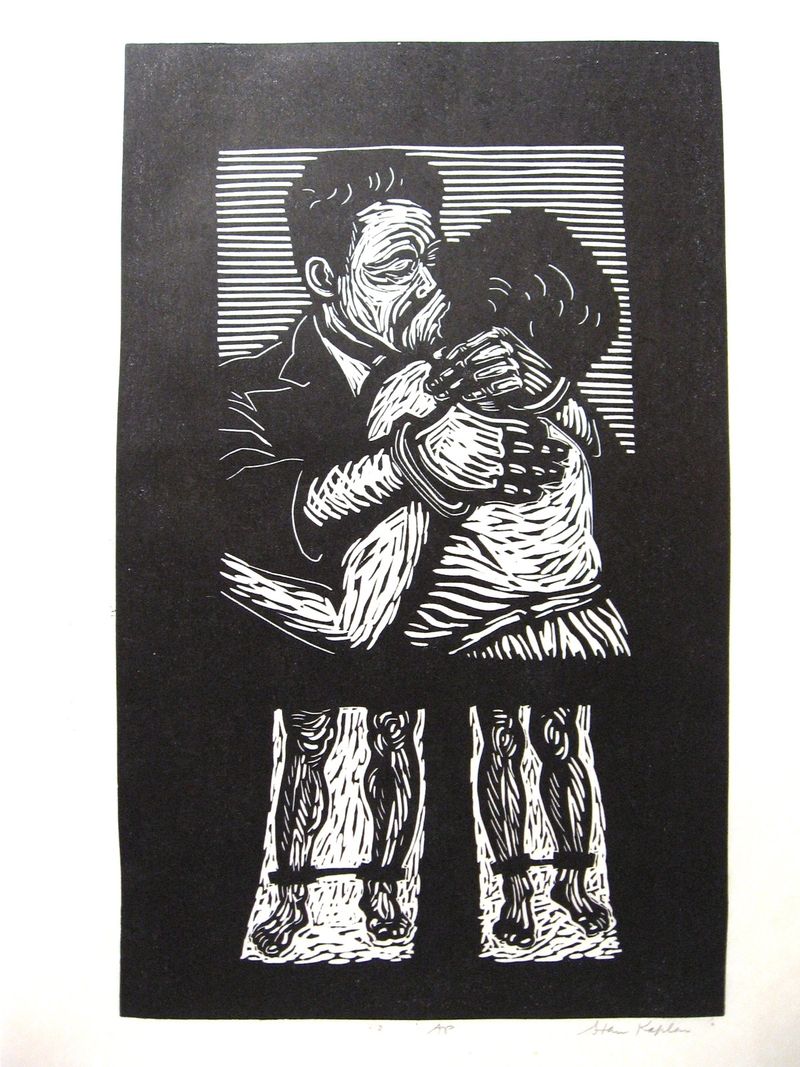
A stark, wholly black-and-white composition, built almost entirely in white line against solid black — a man and woman locked in an embrace, faces close in a kiss, his wrists bound in handcuffs between them. Below, two pairs of shackled legs stand in isolation, disconnected from the bodies above, the title cutting hard against the tenderness of the embrace itself. This image also appears in Images: Between the Lines, Stan's artist's book, featured in the Artist's Books section of this archive.

The Survivor (from Images: Between the Lines)

Linoleum Cut, 1997 · 24 x 18"

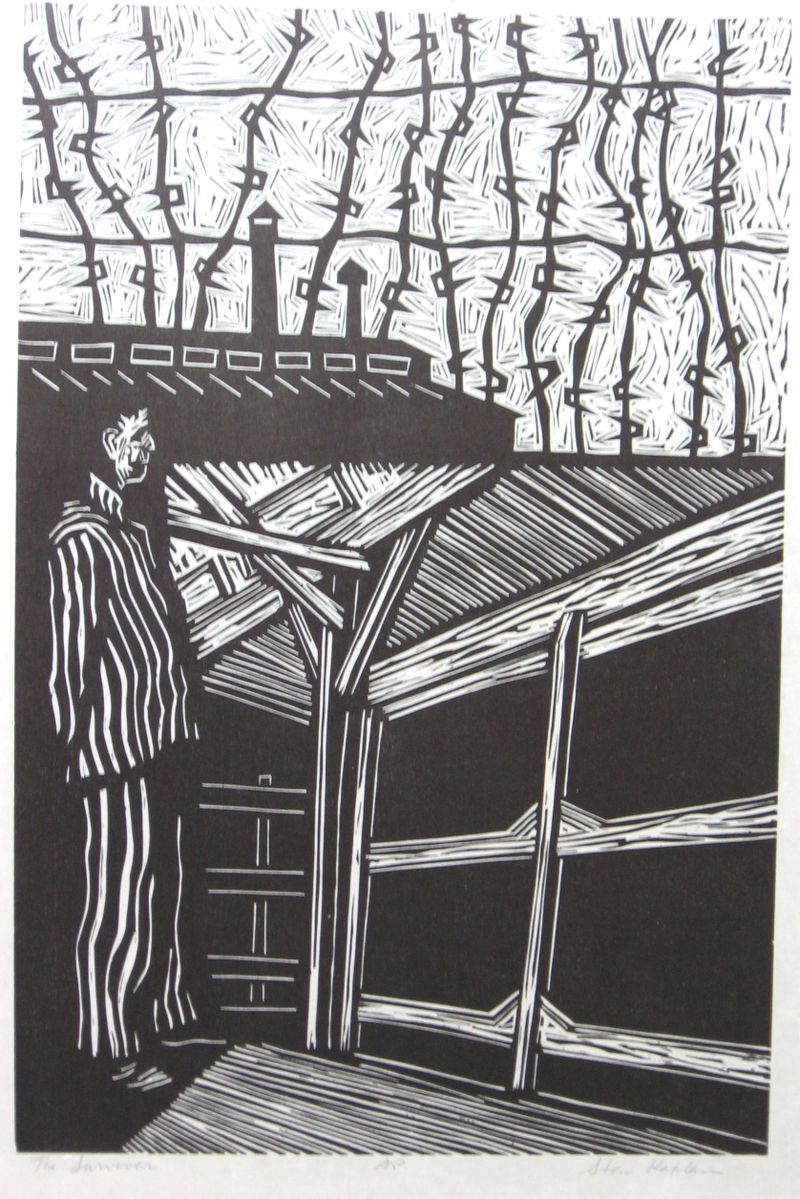
A lone figure in striped prison garb stands beside a wooden guard tower, watching a bleak, wire-tangled sky stretch out above the camp's silhouette. The architecture — beams, rails, fencing — dominates the frame, rendered in the same stark black-and-white line as "Severed," the man dwarfed by the structure around him. This image also appears in Images: Between the Lines, Stan's artist's book, featured in the Artist's Books section of this archive.

Buchenwald

Linocut, 1997 · 9 x 10"

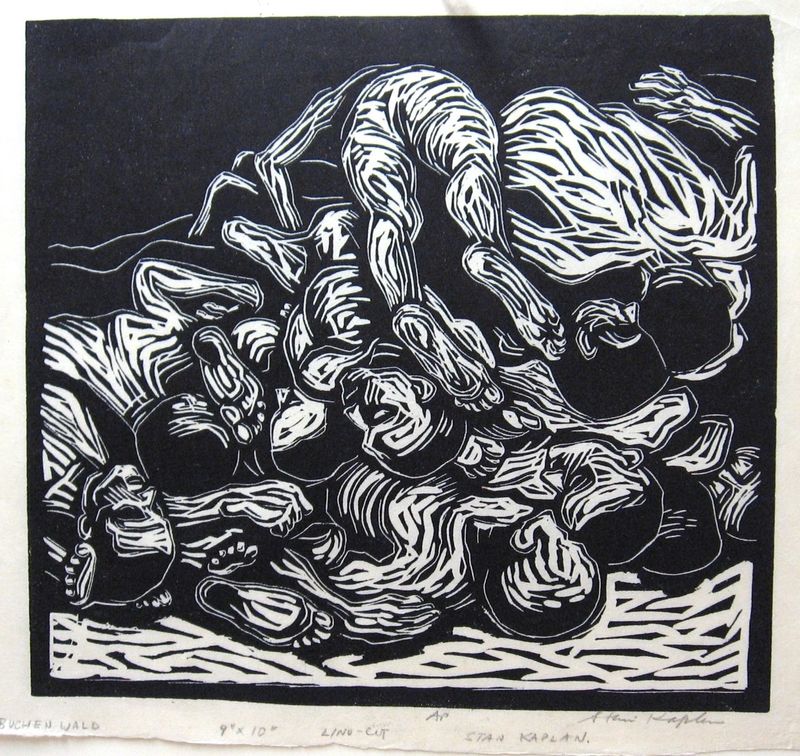
A preparatory study for Images: Between the Lines — bodies rendered in dense, tangled white line against black, pressed together in a way that leaves no room to look away. Among the starkest images in the book's development, it shows Stan working through the weight of the subject in its rawest form before it found its place in the finished pages.

Taking the High Ground (not final)

Linoleum Cut, 1997 · 24 x 18"

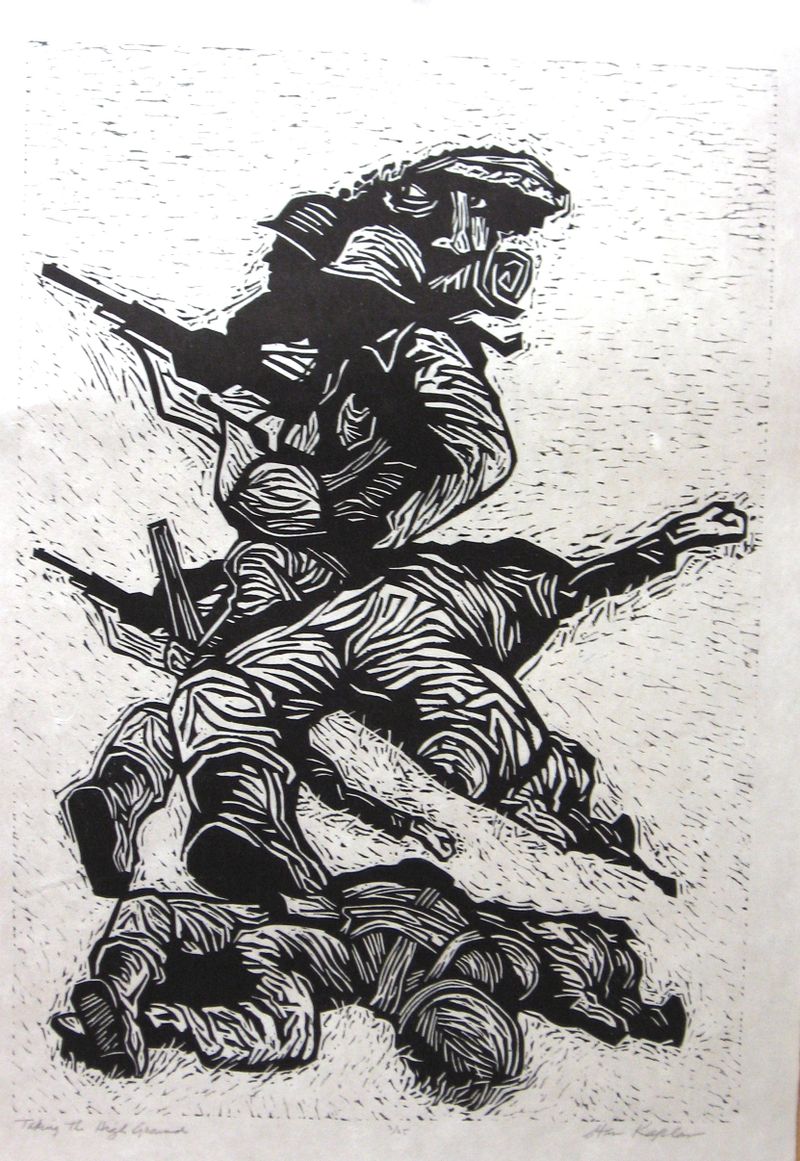
A soldier crouches low with rifle in hand, his shadow rising above him like a ghost of the same figure, helmet and posture doubled and looming. A fallen body lies beneath him, rendered with the same stark, wind-blown line as the rest of the series. An earlier study for the same page in Images: Between the Lines, this version shows Stan working out the composition before arriving at its final form.

Taking the High Ground (final)

Linoleum Cut, 1997 · 24 x 18"

Two soldiers move together up a slope, rifles raised, one climbing behind the other in a tangle of limbs and gear rendered in dense, bristling black line. The composition pushes upward with real physical strain — the sense of ground being taken by force, one exhausted step at a time. This image appears in Images: Between the Lines, Stan's artist's book, featured in the Artist's Books section of this archive.

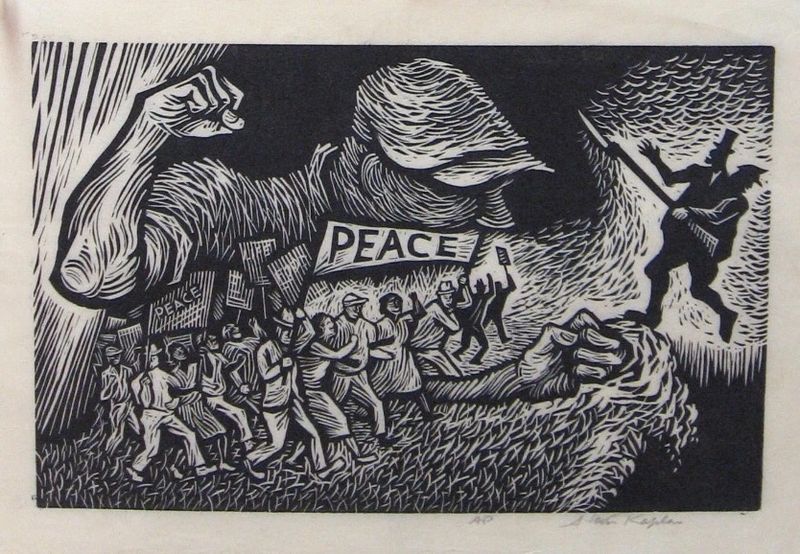
Peace

Woodcut, 1952 · Size TBD

A crowd marches beneath a raised, clenched fist, banners reading "PEACE" held high above the procession. To the right, a top-hatted figure lurks in shadow, watching from the margins — a note of tension pressing against the demonstration's momentum. Dense black and bold white line give the whole scene the charged energy of a woodcut poster, urgent and unresolved — one of a small group of prints touched by his years with the Taller de Gráfica Popular.

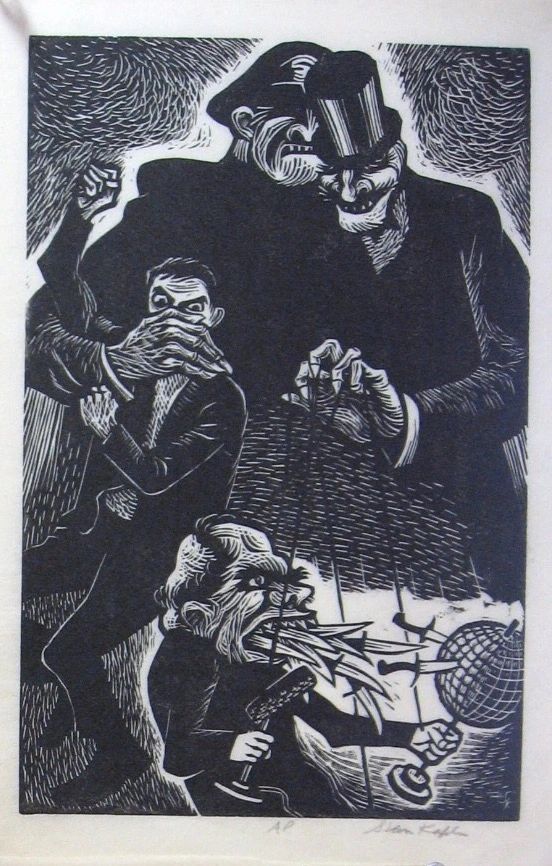
Untitled

Woodcut, 1952 · Size TBD

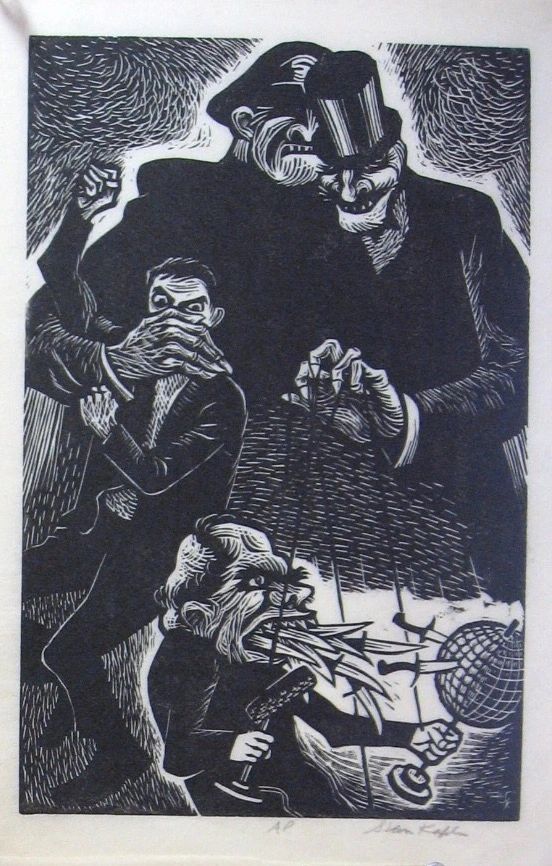
The same top-hatted figure from "Peace" reappears here in a darker role — looming over a man whose mouth is silenced by a gloved hand, while below, a marionette-like figure spews knives at a globe, strings pulled by unseen hands. Menacing and theatrical, the print continues the same warning against power and manipulation, made in the same politically charged spirit Stan carried forward from his time with the Taller de Gráfica Popular. The piece also lives in the Taller de Gráfica Popular section.

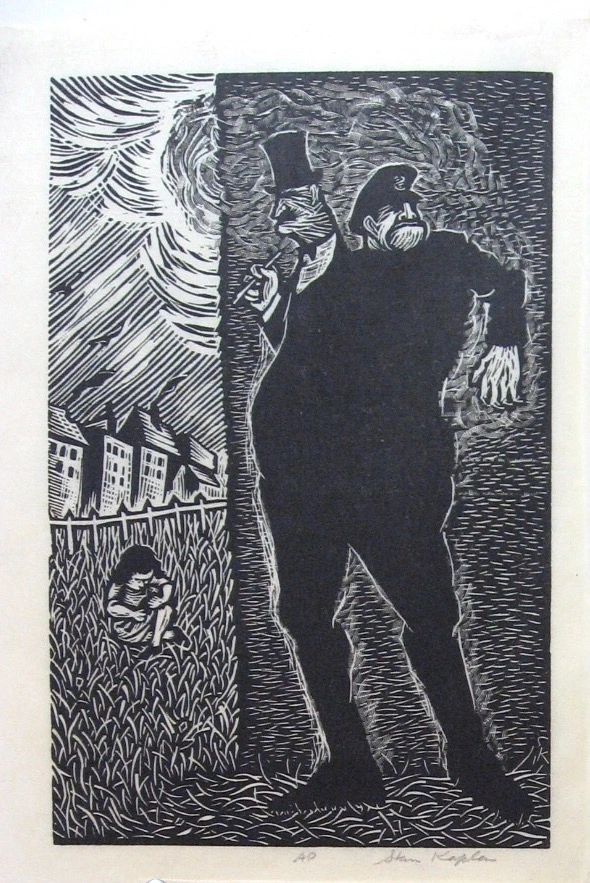
Untitled

Woodcut, 1952 · Size TBD

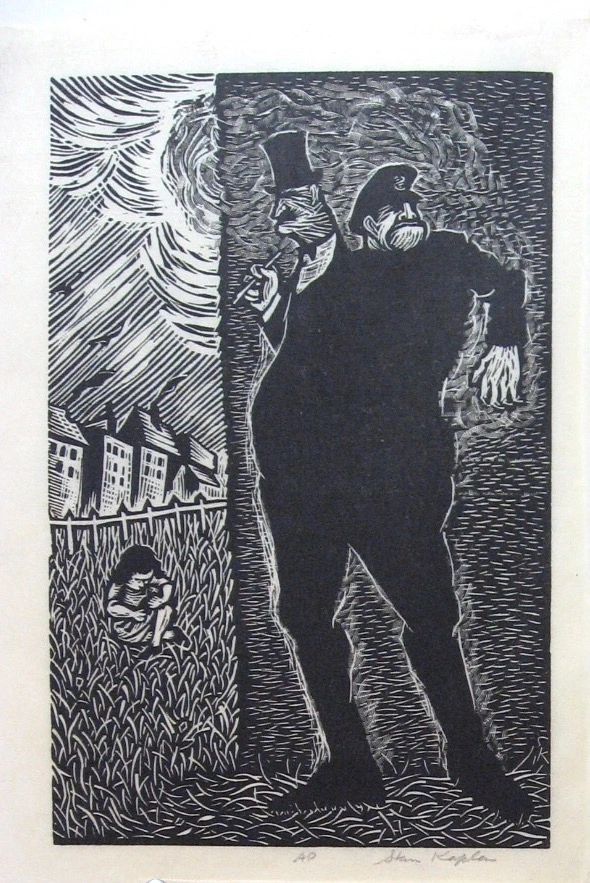
The same top-hatted, monolithic figure looms once more, this time standing over a bleak landscape — a distant tenement skyline, a churning smoke-filled sky, and a small, huddled figure alone in the field below. The power dynamic feels almost architectural: the man's dark bulk fills most of the frame, dwarfing the vulnerable figure in the grass. Part of the same 1952 group, carrying forward the same charged, TGP-influenced political voice. The piece also lives in the Taller de Gráfica Popular section.

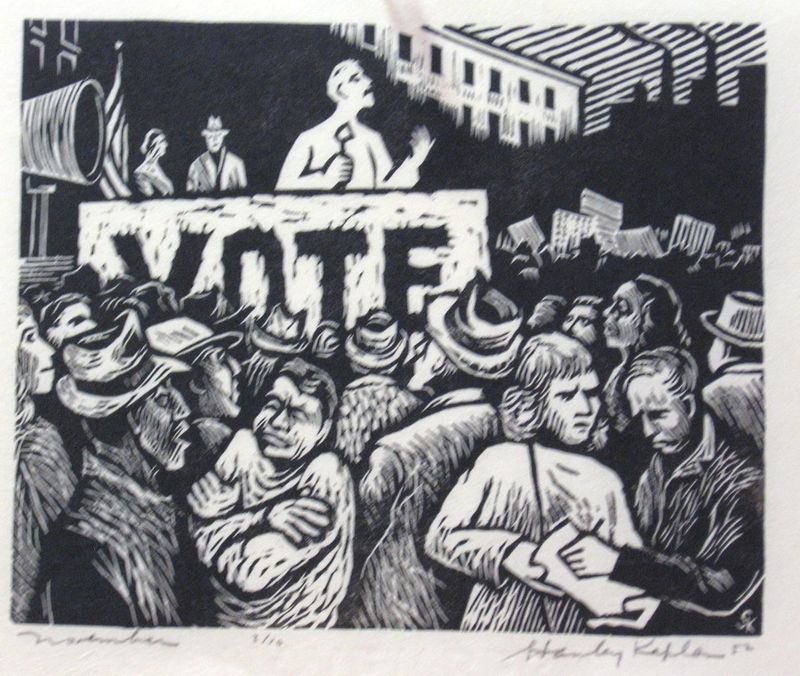
Vote

Vote

Vote

Woodcut, 1952 · Size TBD

A speaker addresses a dense, upturned crowd from a podium banner reading "VOTE," megaphone and flags framing the scene above a sea of listening faces. Tightly packed, richly detailed figures fill the foreground, each rendered with individual expression and attention. Another of the 1952 group, its call to civic participation carrying the same politically engaged spirit Stan brought back from his time with the Taller de Gráfica Popular. 

Back to Prints

© 2026 KaplanPrints | All images and content are the property of the Estate of Stanley Kaplan

  • Home
  • Explore the Archive
  • Gallery
  • The Story
  • About

Powered by

This website uses cookies.

We use cookies to analyze website traffic and optimize your website experience. By accepting our use of cookies, your data will be aggregated with all other user data.

Accept