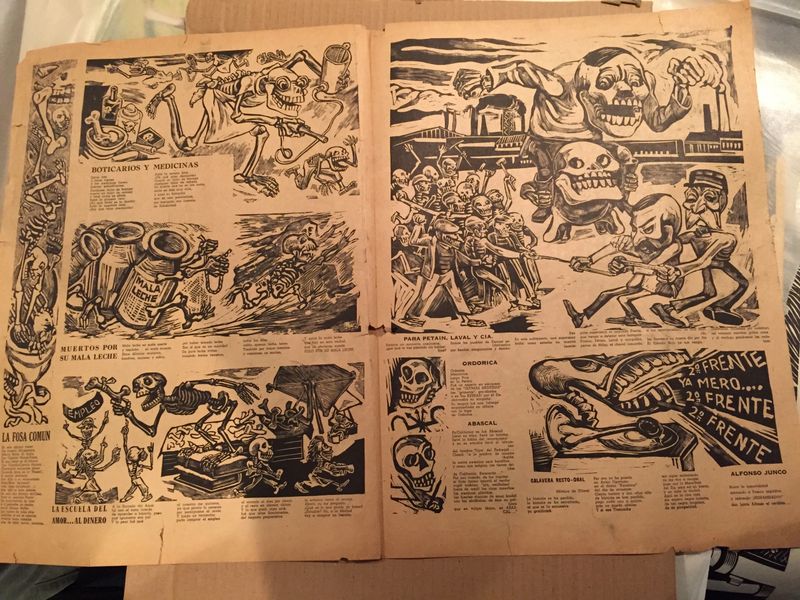
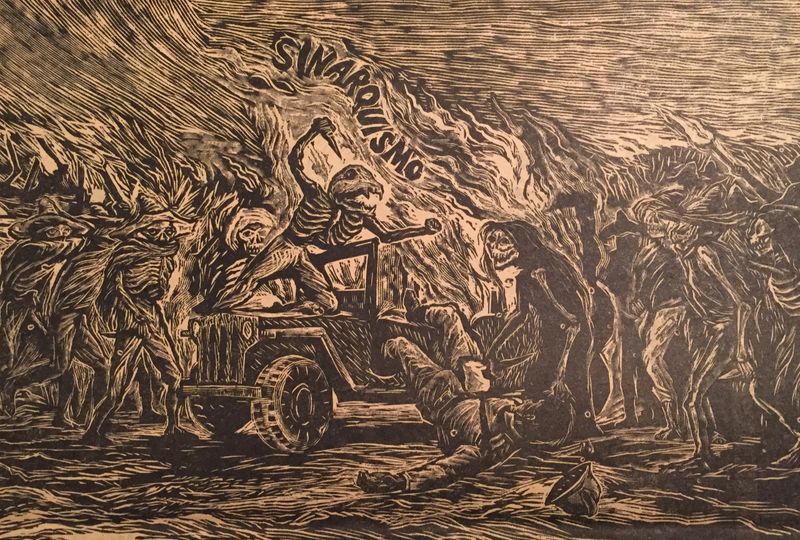
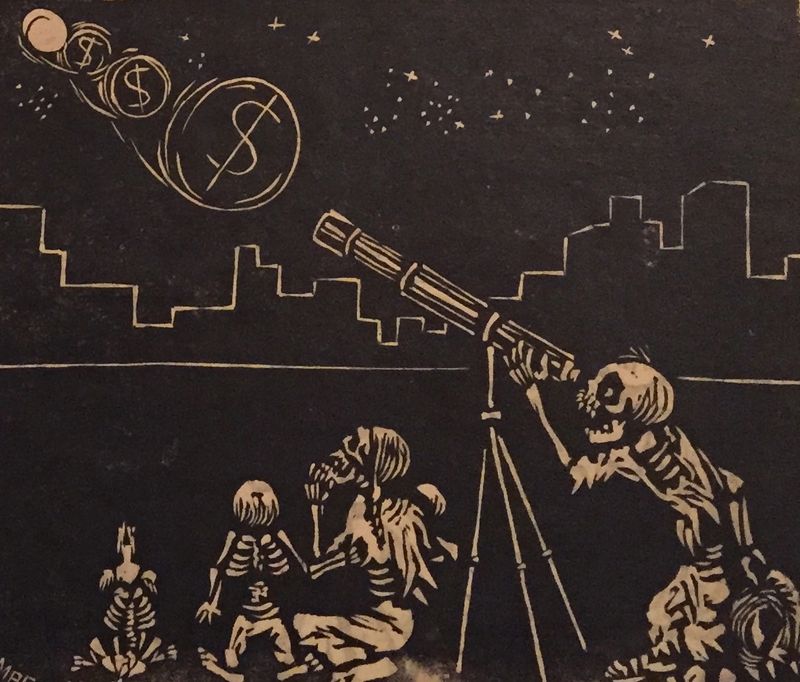
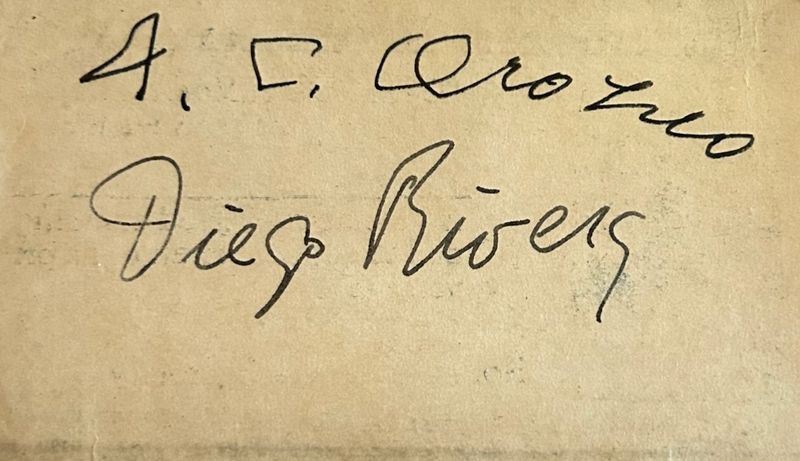
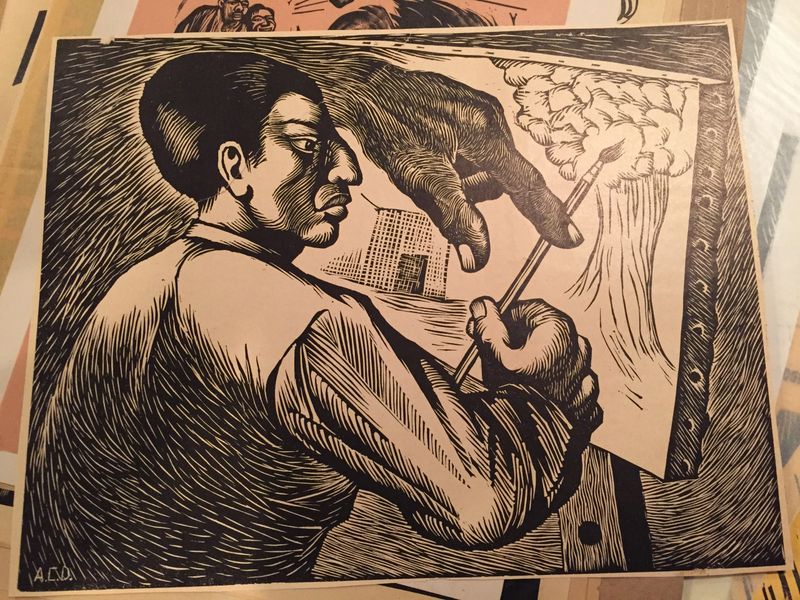
In the years just after World War II, Jules Heller — a printmaker at UCLA — suggested that Stan's brother Seymour make the trip to Mexico City to work with the Taller de Gráfica Popular. Seymour brought Stan along. Stan was 23, at the very start of his career. The TGP was a collective where printmaking served social justice, anti-fascism, and the lives of ordinary people. The influence never left him. Seymour's lithographs from that time appear at the bottom of this page.
Years later, when Rob was hired to teach at Arizona State University, Jules Heller was his Dean at the College of Fine Arts — the same person who had sent Stan and Seymour to Mexico City decades before.


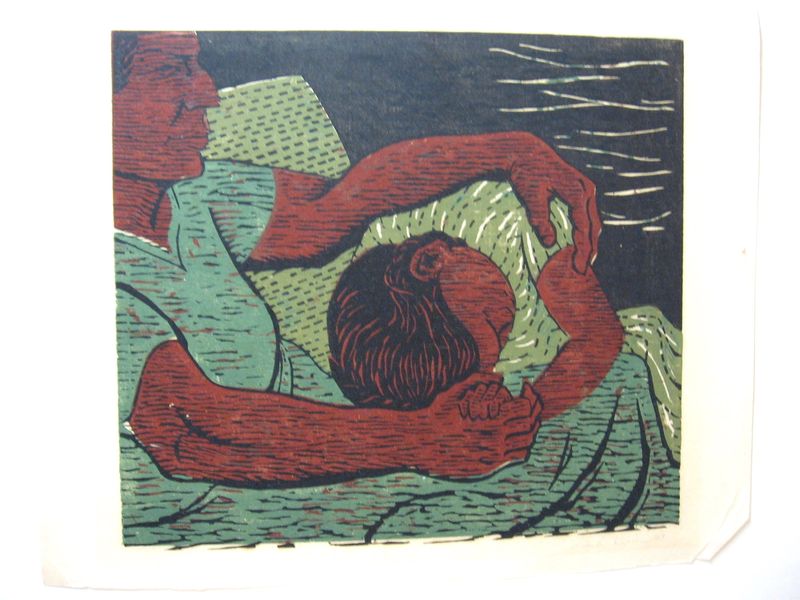
Color Woodcut, 1948 · [Size: TBD]
A woman folds her whole body around a sleeping child — arms doubled back on themselves, one cradling, one guarding. Deep red, sage green, and black, cut in bold, unshaded planes. The same directness he carried home from his years with the Taller de Gráfica Popular.

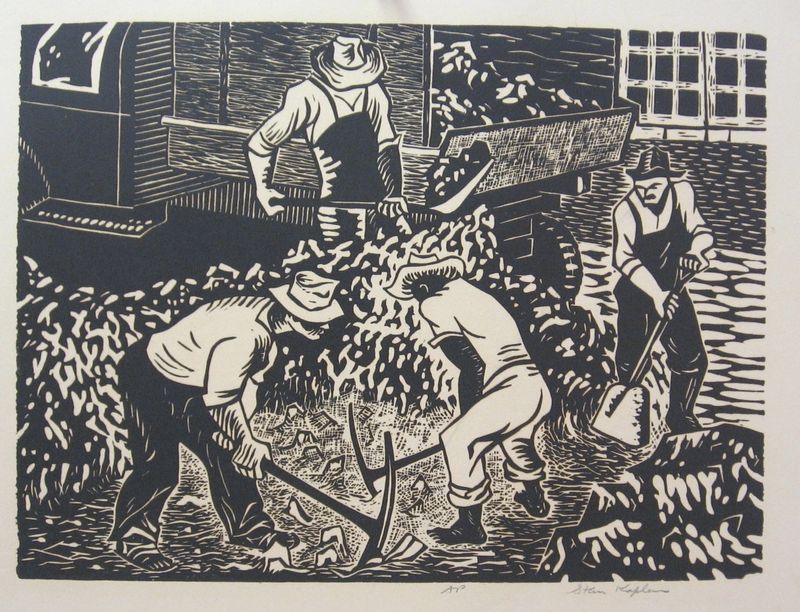
Woodcut, 1949 · [Size: TBD]
Four men break ground with pick and shovel, hats low against the sun, a truck bed already half-loaded behind them. Rendered entirely in black and white, the crosshatching doing all the work — dense where the labor is hardest, open where the men catch a breath. Marked as an artist's proof.
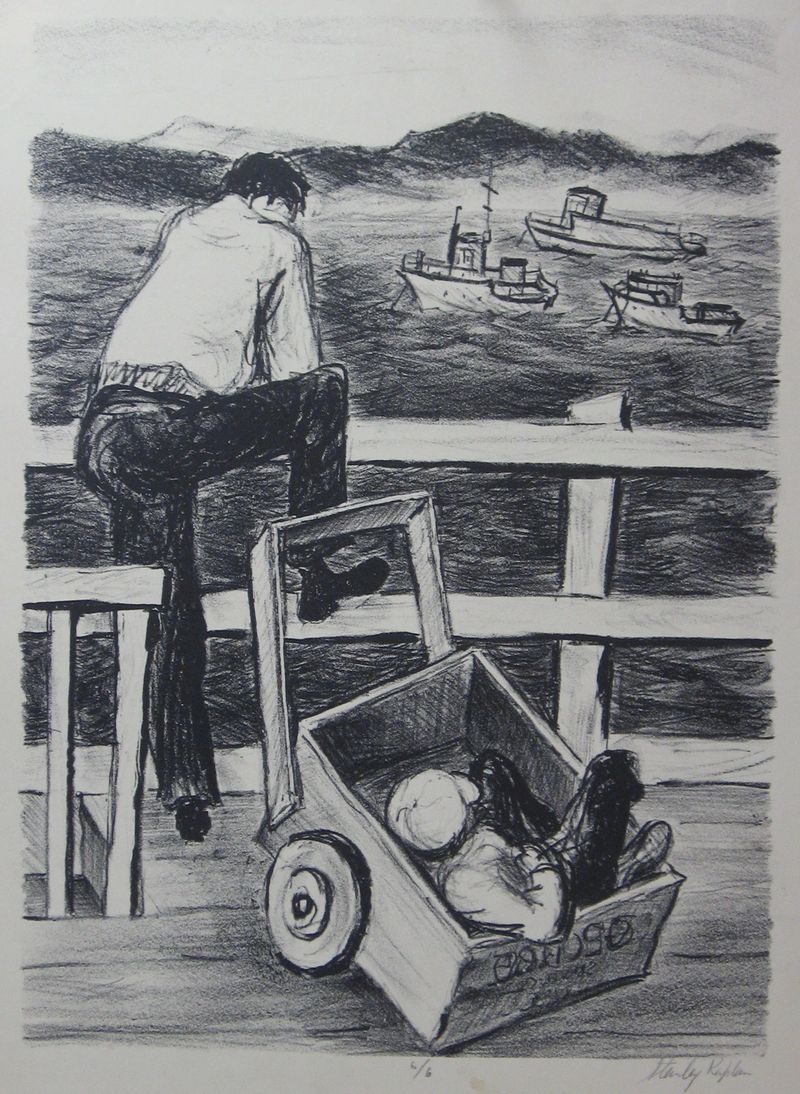
Lithograph, 1949 · Size TBD
A man watches the harbor from a dock railing while a child sleeps below in a wheelbarrow — mountains rising hazy in the distance. The piece also lives in People and Family.
Linoleum Cut, 1948 · [Size: TBD]
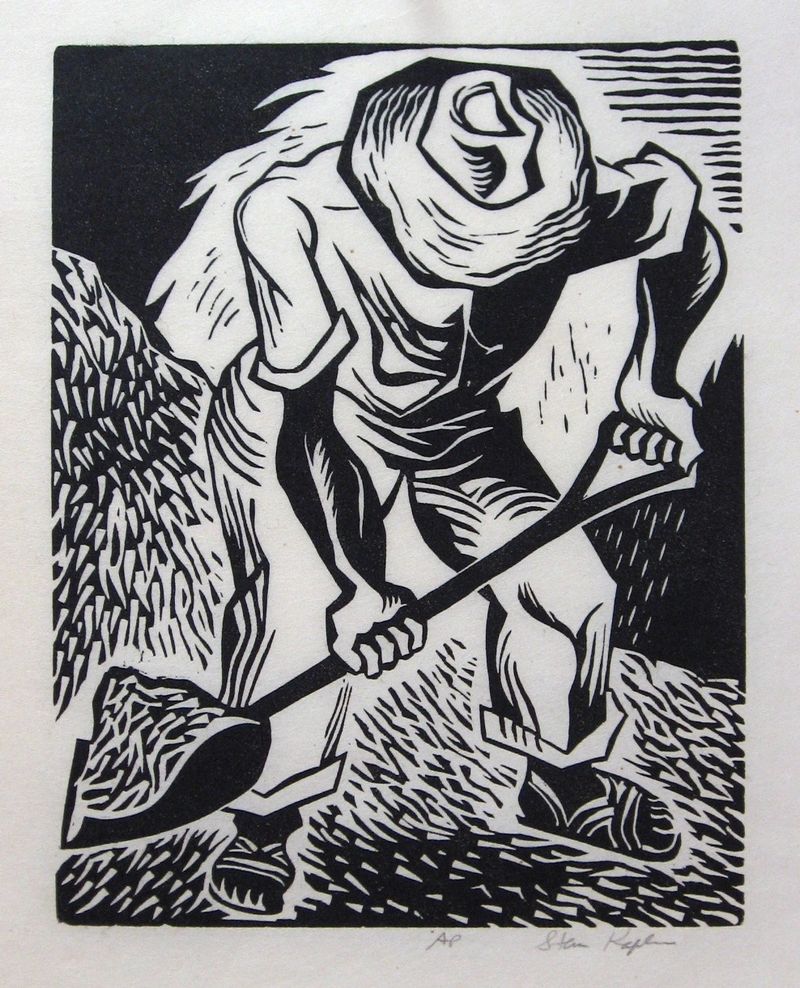
A single figure bent low over a shovel, wrapped head to shoulder against sun or dust, the ground rising around him in dense, jagged strokes. Bold black-and-white, close in, no horizon — just the figure and the labor. Marked as an artist's proof.

Linoleum Cut, 1985 · [Size: TBD]
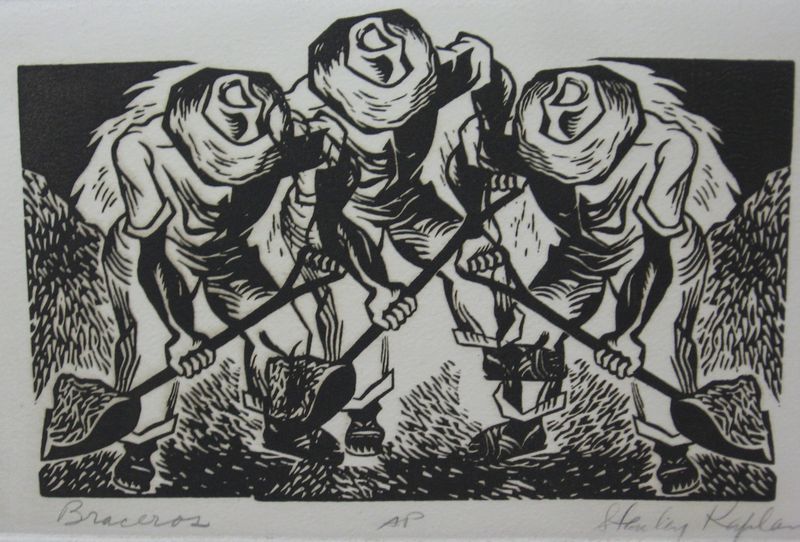
Three figures bend into rhythm, shovels crossing in a single repeated gesture — the same pose echoed three times until the labor itself becomes the composition. The title recalls the Bracero Program, which brought Mexican laborers into the U.S. under government contract for decades. Bold black-and-white, hats low, faces nearly interchangeable. Marked as an artist's proof.

Woodcut, 1951 · [Size: TBD]
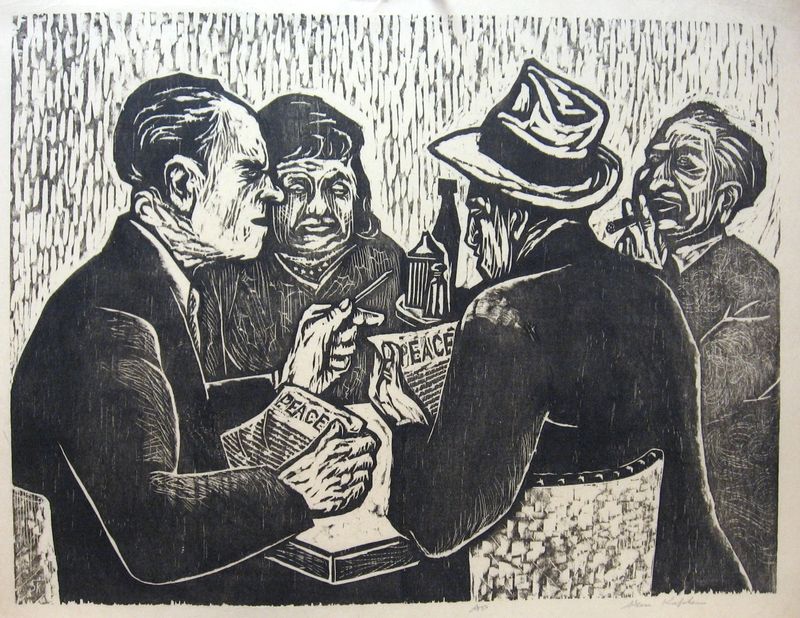
Four men crowd close around a café table, newspapers folded to show a single word — PEACE — passing hand to hand as the conversation leans in. A cigar, bottles clustered at the table's edge, faces drawn sharp with argument or agreement. Dense vertical hatching fills the air itself. Marked as an artist's proof.
Woodcut, 1952 · [Size: TBD]
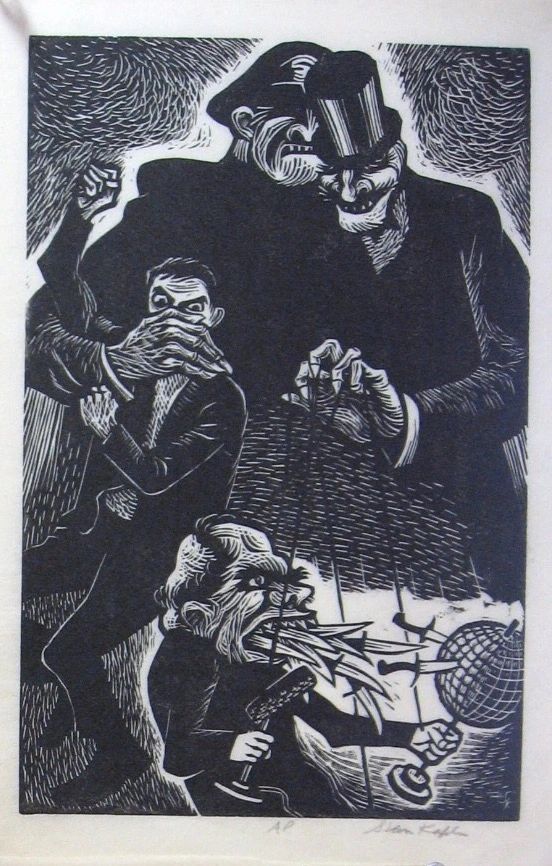
The same top-hatted figure from "Peace" looms over a man silenced by a gloved hand, while a marionette figure below spews knives at a globe on unseen strings. The piece also lives in Witness to History.
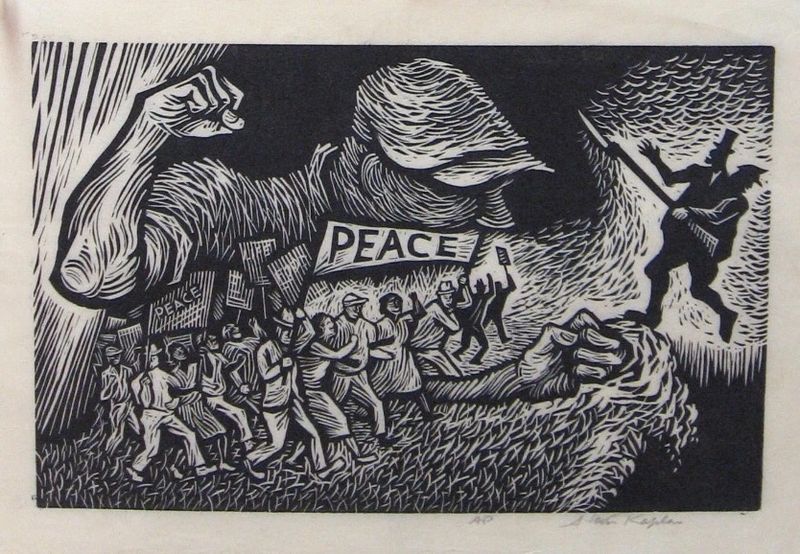
Woodcut, 1952 · [Size: TBD]
A crowd marches beneath a raised fist, banners reading "PEACE" held high — a top-hatted figure watching from the shadows at the margin. The piece also lives in Witness to History.
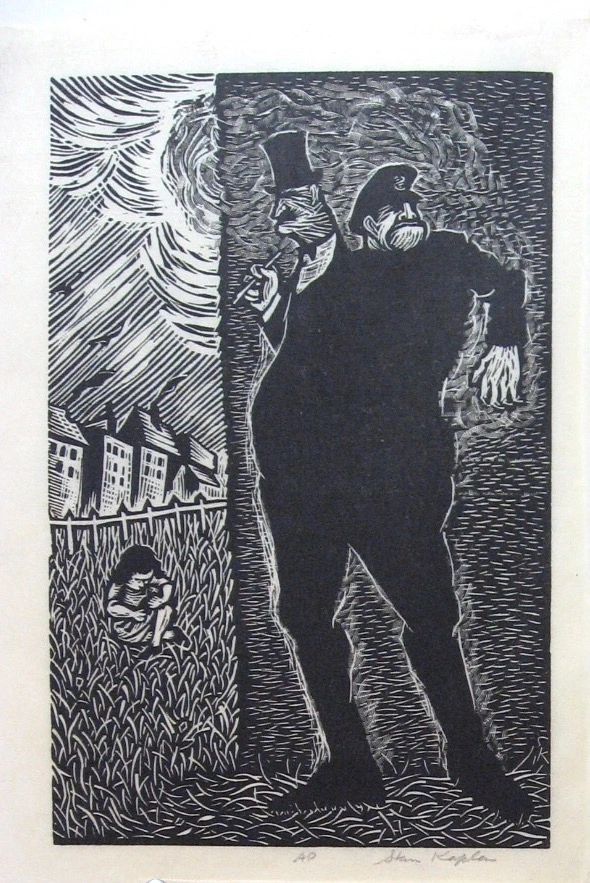
Woodcut, 1952 · [Size: TBD]
The same top-hatted, monolithic figure looms over a bleak landscape — a tenement skyline, a smoke-filled sky, and a small, huddled figure alone in the field below. The piece also lives in Witness to History.
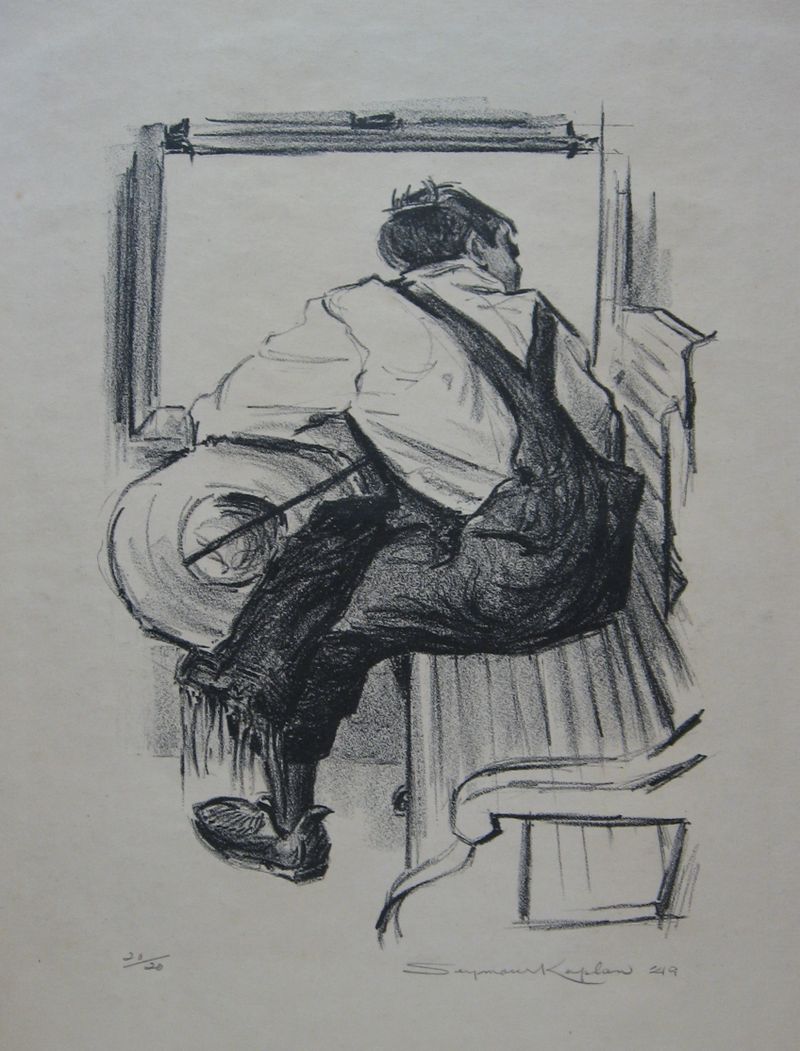
Lithograph, 1949 · [Size: TBD]
A man rides in profile, one arm slung over the seatback, hat resting beside him, gaze fixed somewhere out the window. Rendered in soft, layered crayon strokes rather than Stan's carved line — a different hand, the same eye for a quiet, unguarded moment.
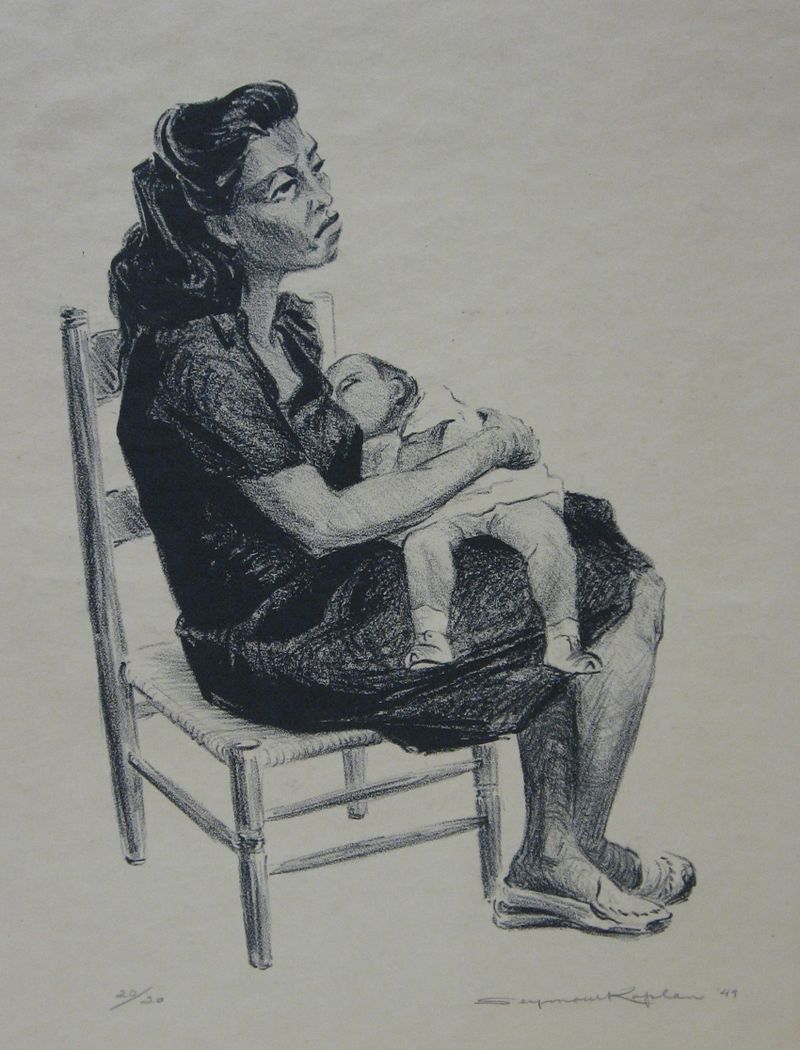
Lithograph, 1949 · [Size: TBD]
A woman sits turned in her chair, a sleeping child gathered against her chest, bare feet in worn sandals. Drawn with the same tender attention as Stan's own Mexico work from this period — brothers, a year apart, toward the same subject.
© 2026 KaplanPrints | All images and content are the property of the Estate of Stanley Kaplan
We use cookies to analyze website traffic and optimize your website experience. By accepting our use of cookies, your data will be aggregated with all other user data.