Ya no hay tiempo (There isn't time now), from Goya's Disaste

Francisco Goya's (1746–1828) art bore witness to war and human suffering — across painting, drawing, and printmaking. For Stan, encountering Goya's Disasters of War etchings at the Met was a turning point — it sparked Between the Lines, his own series rooted in World War II experience.
Goya: The Third of May
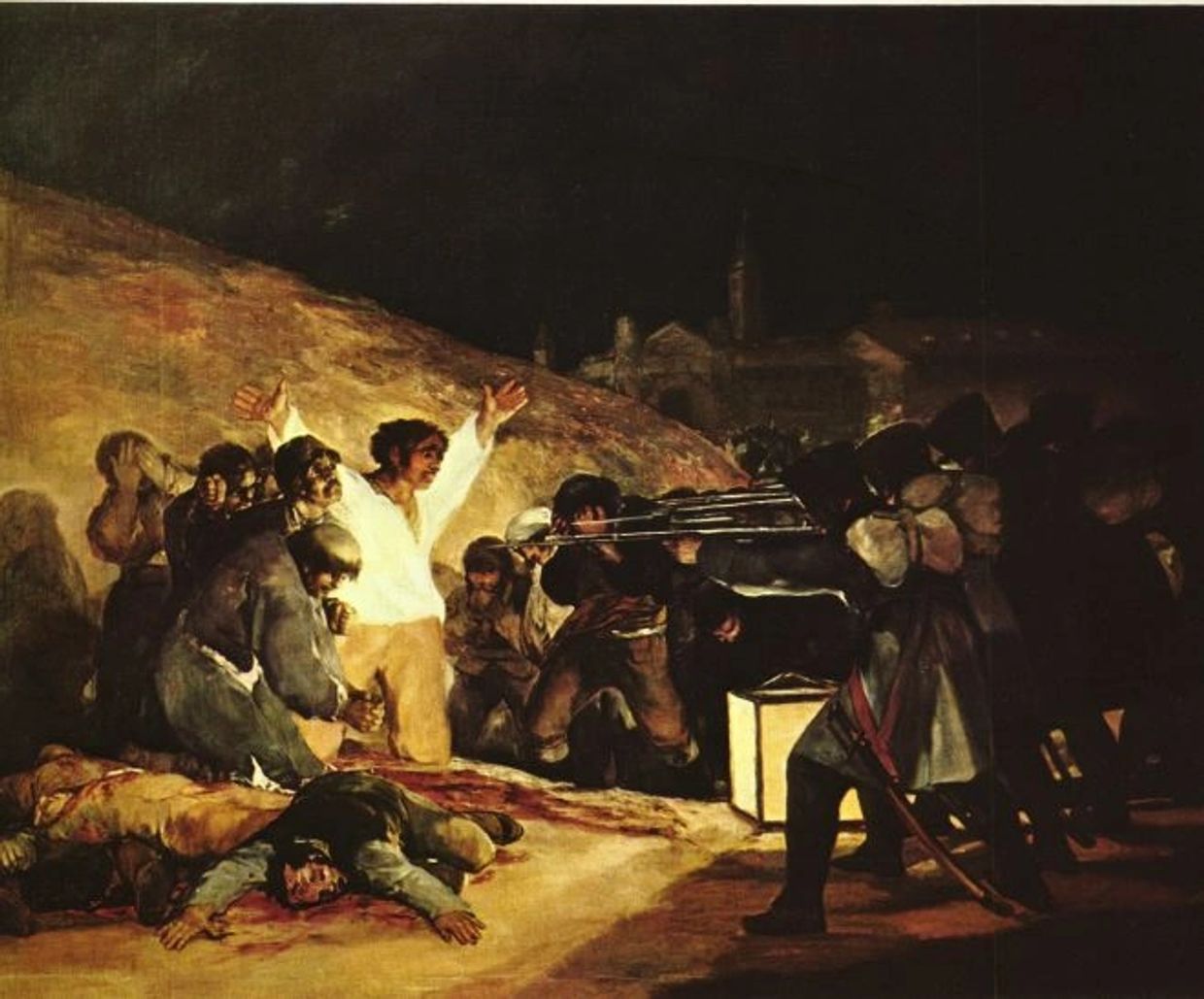
He also made a close visual analysis of The Third of May, studying how Goya transformed historical violence into something that still stops you cold.
Visual Breakdown of Goya's Painting
The Third of May (1808)
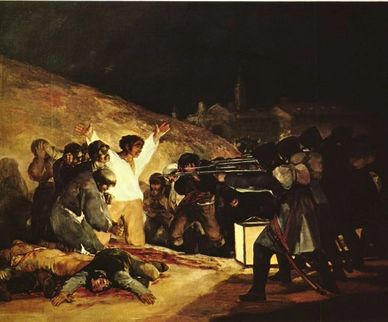
At nearly 9 by 11 feet, Goya's canvas isn't something you look at so much as stand inside — the scale alone puts the viewer at ground level with the condemned. Stan returned to it more than once: the arc dividing victims from aggressors, the light falling exactly where the eye needs to land, the crowd resolving into a handful of essential shapes. It's a painting built on structure as much as feeling.
Goya Study—Compositional Arcs
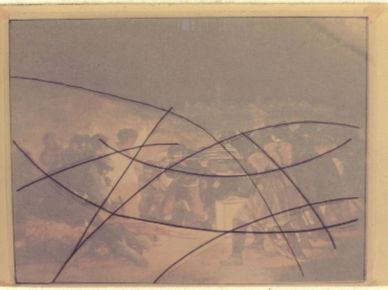
Stan laid these curves directly over a reproduction of "The Third of May" — long, sweeping arcs crossing and recrossing through the crowd, the soldiers, the hillside. One arc, running from the upper left down to the lower right, does the most work: it's the line Goya used to divide the canvas itself, victims on one side, aggressors on the other. Us from them. Stan is looking at Goya from a compositional perspective as well as a literal one.
Goya Study—Colors

A quick color study in warm marker and pen, stripping the painting down to its value structure — the pale hillside and lit shirt against near-black sky and shadow, the crowd rendered as dense masses of brown and rust rather than individual figures. Stan wasn't copying Goya's palette so much as isolating it: where the light falls, where it doesn't, and how little color it actually takes to hold a composition together.
Goya Study—Dark/Light

A dense pen study reducing the painting to pure value — no color at all, just uniform hatching pushed darker or lighter depending on where Goya wanted the eye to land. The figures barely register as figures; they're negative space, carved out of the dark by what's left unmarked. Stripped this far down, the painting reads almost like a woodcut before it's even carved — light and dark doing the same job Stan would later ask them to do in his own prints.
Goya Study—Shapes

Here Stan traces the figures down to their essential outlines — hard, simplified silhouettes with dotted lines marking the rhythms and directions moving between them. The kneeling man's raised arms form a clean, unmistakable shape that also separates him from the people huddled at the lower left. The soldiers fold into a single angular mass, its edge pushing across the dividing arc into the victims' space — just as the resisting figures on the other side reach back into the soldiers'. The line between them isn't as fixed as it first appears.
Goya Study—Vertical/Horizontal
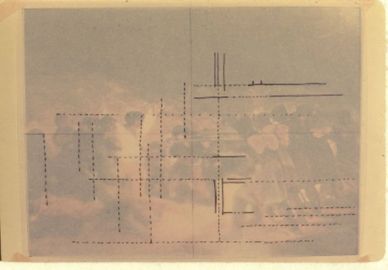
A grid of dashed verticals and horizontals laid over the composition, mapping the hidden architecture beneath the chaos — where a raised arm lines up with a distant rooftop, where a shoulder falls exactly on a horizontal drawn from the crowd behind it. Underneath the arcs and the drama, Stan found a quieter structure holding everything in place: a scaffold of straight lines the eye never consciously sees.
Study After Goya—Kaplan
Study After Goya—Kaplan
Study After Goya—Kaplan

Linoleum Cut, 1997 · [Size: TBD]
Everything the studies uncovered converges here — the raised arms, the dividing arc now a jagged hillside, the crowd folded into a single dense mass on the right. Stan also made a deliberate shift: where Goya's canvas spreads the confrontation out horizontally, across a wide stage, Stan turned it vertical — stacking the sky, the skyline, and the crowd into a single column. The effect isn't the same. Instead of witnessing a standoff across open ground, the eye feels something bearing down. A study in every sense, but a finished print — Goya's painting carved back into Stan's own hand, and reimagined in the process.